
Swipe left or right to explore the full map.
* Equal Contribution | † Corresponding Author
- TCSVT
 Yolo Y. Tang, Jing Bi, Siting Xu, Luchuan Song, Susan Liang, Teng Wang, Daoan Zhang, Jie An, Jingyang Lin, Rongyi Zhu, and 10 more authorsIEEE Transactions on Circuits and Systems for Video Technology (TCSVT), 2025
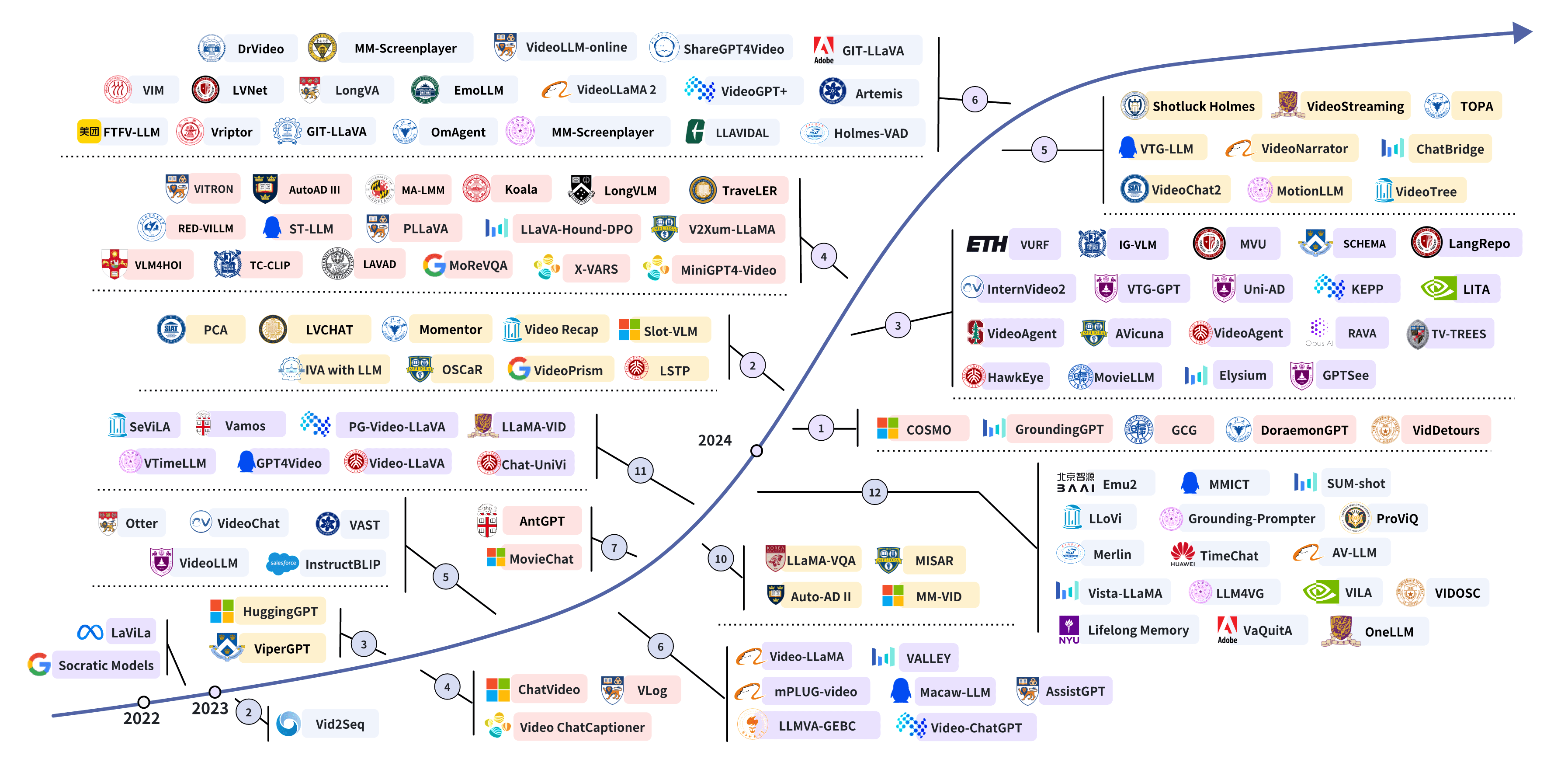
With the burgeoning growth of online video platforms and the escalating volume of video content, the demand for proficient video understanding tools has intensified markedly. Given the remarkable capabilities of large language models (LLMs) in language and multimodal tasks, this survey provides a detailed overview of recent advancements in video understanding that harness the power of LLMs (Vid-LLMs). The emergent capabilities of Vid-LLMs are surprisingly advanced, particularly their ability for open-ended multi-granularity (general, temporal, and spatiotemporal) reasoning combined with commonsense knowledge, suggesting a promising path for future video understanding. We examine the unique characteristics and capabilities of Vid-LLMs, categorizing the approaches into three main types: Video Analyzer x LLM, Video Embedder x LLM, and (Analyzer + Embedder) x LLM. Furthermore, we identify five sub-types based on the functions of LLMs in Vid-LLMs: LLM as Summarizer, LLM as Manager, LLM as Text Decoder, LLM as Regressor, and LLM as Hidden Layer. Furthermore, this survey presents a comprehensive study of the tasks, datasets, benchmarks, and evaluation methodologies for Vid-LLMs. Additionally, it explores the expansive applications of Vid-LLMs across various domains, highlighting their remarkable scalability and versatility in real-world video understanding challenges. Finally, it summarizes the limitations of existing Vid-LLMs and outlines directions for future research. For more information, readers are recommended to visit the repository at https://github.com/yunlong10/awesome-llms-for-video-understanding.
@article{vidllmsurvey, title = {Video Understanding with Large Language Models: A Survey}, author = {Tang, Yolo Y. and Bi, Jing and Xu, Siting and Song, Luchuan and Liang, Susan and Wang, Teng and Zhang, Daoan and An, Jie and Lin, Jingyang and Zhu, Rongyi and Vosoughi, Ali and Huang, Chao and Zhang, Zeliang and Liu, Pinxin and Feng, Mingqian and Zheng, Feng and Zhang, Jianguo and Luo, Ping and Luo, Jiebo and Xu, Chenliang}, journal = {IEEE Transactions on Circuits and Systems for Video Technology (TCSVT)}, year = {2025}, publisher = {IEEE}, } -
 Teng Wang*, Jinrui Zhang*, Junjie Fei*, Hao Zheng, Yolo Y. Tang, Zhe Li, Mingqi Gao, and Shanshan ZhaoarXiv preprint arXiv:2305.02677, 2023
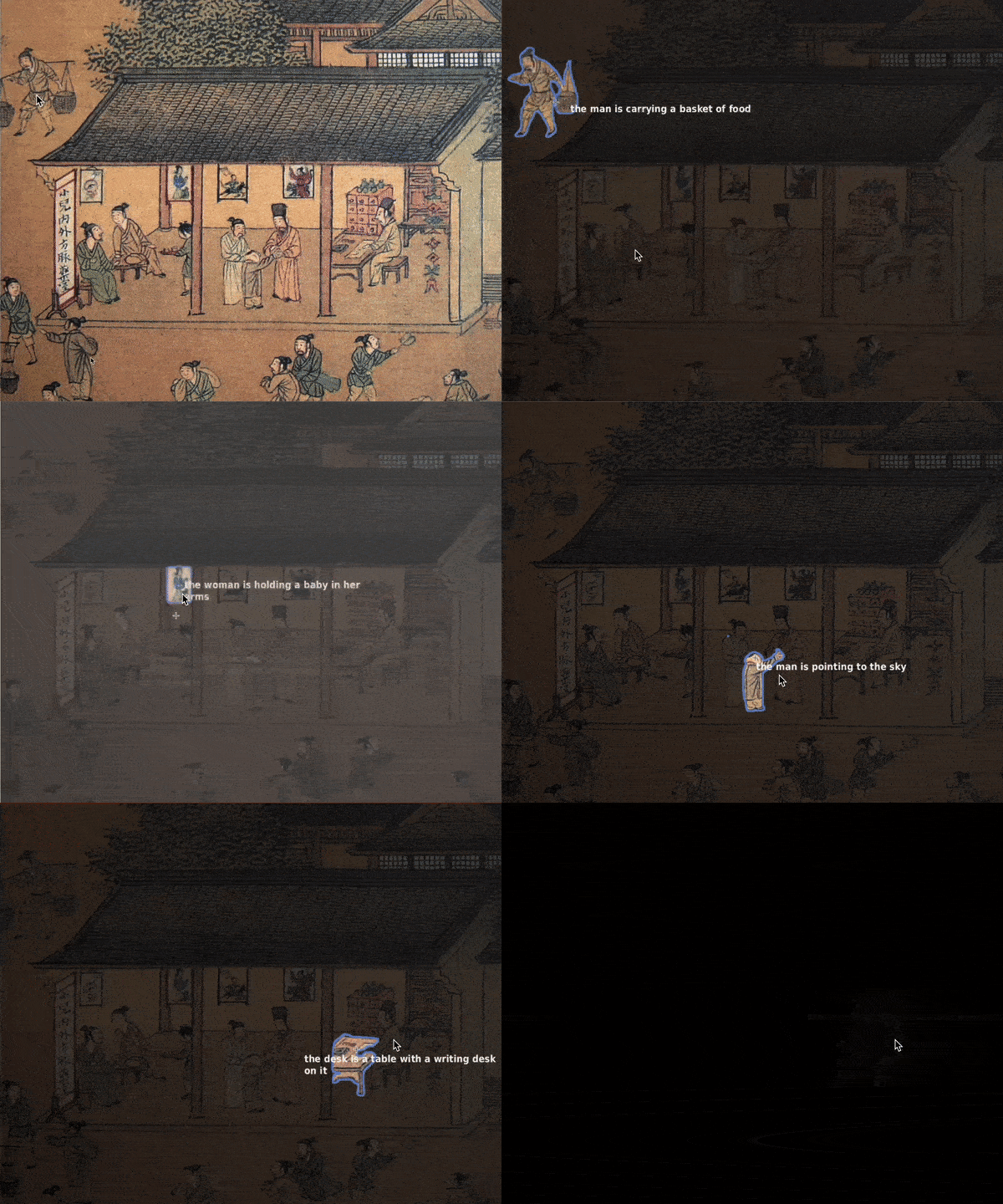
Controllable image captioning is an emerging multimodal topic that aims to describe the image with natural language following human purpose, e.g., looking at the specified regions or telling in a particular text style. State-of-the-art methods are trained on annotated pairs of input controls and output captions. However, the scarcity of such well-annotated multimodal data largely limits their usability and scalability for interactive AI systems. Leveraging unimodal instruction-following foundation models is a promising alternative that benefits from broader sources of data. In this paper, we present Caption AnyThing (CAT), a foundation model augmented image captioning framework supporting a wide range of multimodel controls: 1) visual controls, including points, boxes, and trajectories; 2) language controls, such as sentiment, length, language, and factuality. Powered by Segment Anything Model (SAM) and ChatGPT, we unify the visual and language prompts into a modularized framework, enabling the flexible combination between different controls. Extensive case studies demonstrate the user intention alignment capabilities of our framework, shedding light on effective user interaction modeling in vision-language applications. Our code is publicly available at https://github.com/ttengwang/caption-anything
@article{wang2023caption, title = {Caption Anything: Interactive Image Description with Diverse Multimodal Controls}, author = {Wang, Teng and Zhang, Jinrui and Fei, Junjie and Zheng, Hao and Tang, Yolo Y. and Li, Zhe and Gao, Mingqi and Zhao, Shanshan}, journal = {arXiv preprint arXiv:2305.02677}, year = {2023}, } - AAAI
 Hang Hua*, Yolo Y. Tang*, Chenliang Xu, and Jiebo LuoIn Proceedings of the AAAI Conference on Artificial Intelligence (AAAI), 2025
@inproceedings{hua2024v2xum, title = {V2Xum-LLM: Cross-modal Video Summarization with Temporal Prompt Instruction Tuning}, author = {Hua, Hang and Tang, Yolo Y. and Xu, Chenliang and Luo, Jiebo}, booktitle = {Proceedings of the AAAI Conference on Artificial Intelligence (AAAI)}, volume = {39}, number = {4}, pages = {3599-3607}, year = {2025}, doi = {10.1609/aaai.v39i4.32374}, } - AAAI
 Yolo Y. Tang, Daiki Shimada, Jing Bi, Mingqian Feng, Hang Hua, and Chenliang XuIn Proceedings of the AAAI Conference on Artificial Intelligence (AAAI), 2025
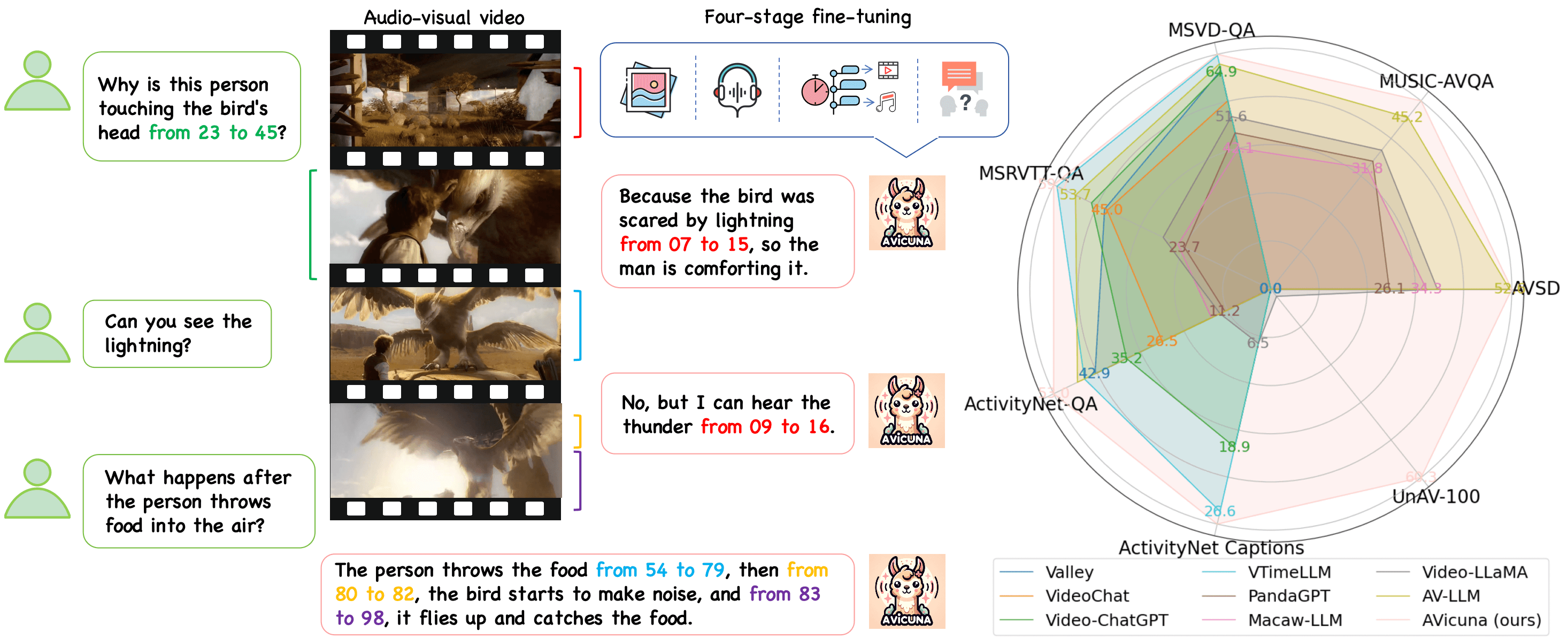
Large language models (LLMs) have demonstrated remarkable capabilities in natural language and multimodal domains. By fine-tuning multimodal LLMs with temporal annotations from well-annotated datasets, e.g., dense video captioning datasets, their temporal understanding capacity in video-language tasks can be obtained. However, there is a notable lack of untrimmed audio-visual video datasets with precise temporal annotations for events. This deficiency hinders LLMs from learning the alignment between time, audio-visual events, and text tokens, thus impairing their ability to localize audio-visual events in videos temporally. To address this gap, we introduce PU-VALOR, a comprehensive audio-visual dataset comprising over 114,000 pseudo-untrimmed videos with detailed temporal annotations. PU-VALOR is derived from the large-scale but coarse-annotated audio-visual dataset VALOR, through a subtle method involving event-based video clustering, random temporal scaling, and permutation. By fine-tuning a multimodal LLM on PU-VALOR, we developed AVicuna, a model capable of aligning audio-visual events with temporal intervals and corresponding text tokens. AVicuna excels in temporal localization and time-aware dialogue capabilities. Our experiments demonstrate that AVicuna effectively handles temporal understanding in audio-visual videos and achieves state-of-the-art performance on open-ended video QA, audio-visual QA, and audio-visual event dense localization tasks.
@inproceedings{tang2024avicuna, title = {Empowering LLMs with Pseudo-Untrimmed Videos for Audio-Visual Temporal Understanding}, author = {Tang, Yolo Y. and Shimada, Daiki and Bi, Jing and Feng, Mingqian and Hua, Hang and Xu, Chenliang}, booktitle = {Proceedings of the AAAI Conference on Artificial Intelligence (AAAI)}, volume = {39}, number = {7}, pages = {7293-7301}, year = {2025}, doi = {10.1609/aaai.v39i7.32784}, } - ICCV Workshop
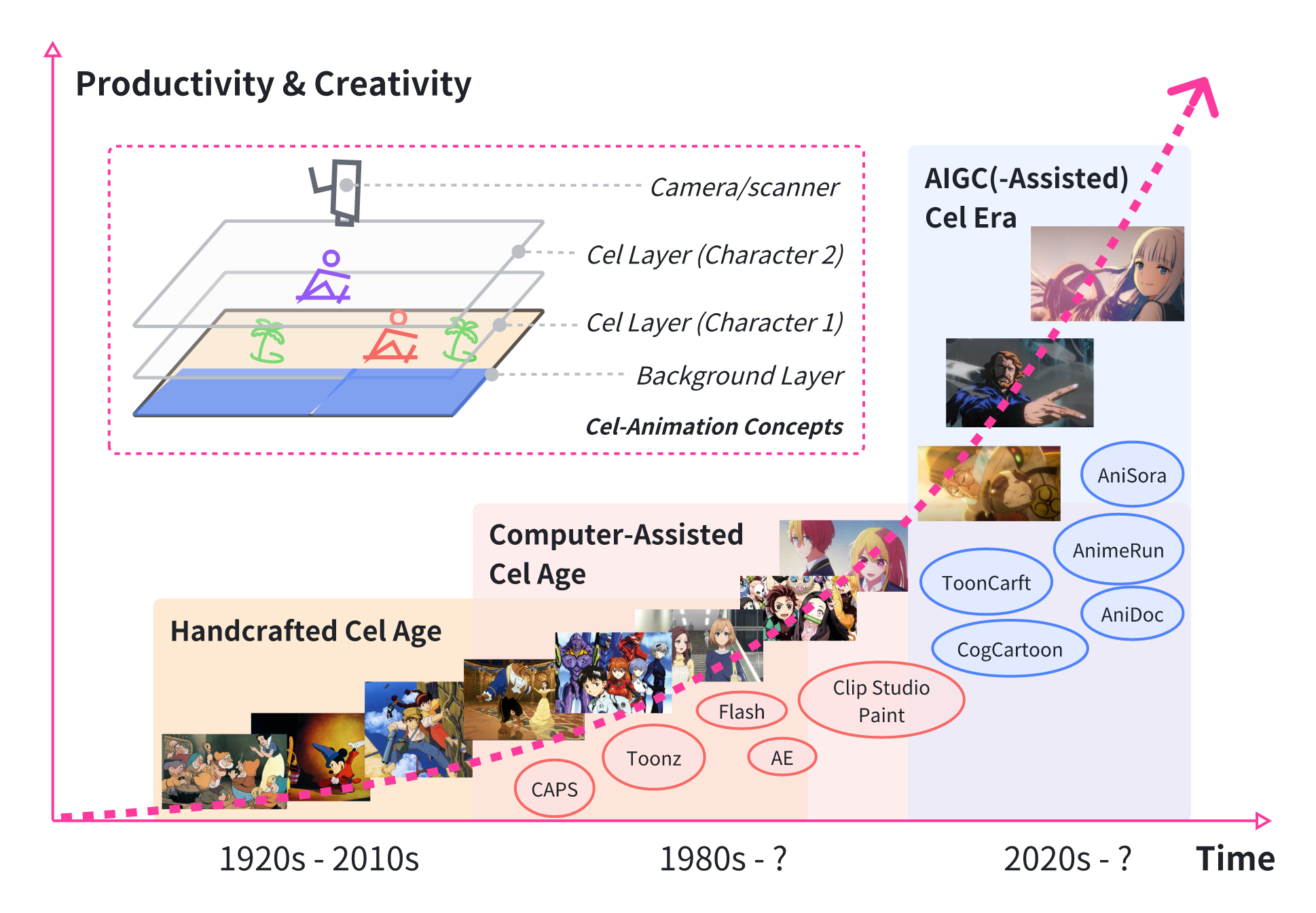 Yolo Y. Tang, Junjia Guo, Pinxin Liu, Zhiyuan Wang, Hang Hua, Jia-Xing Zhong, Yunzhong Xiao, Chao Huang, Luchuan Song, Susan Liang, and 7 more authorsProceedings of the IEEE/CVF International Conference on Computer Vision (ICCV) Workshops, 2025
@article{tang2025ai4anime, title = {Generative AI for Cel-Animation: A Survey}, author = {Tang, Yolo Y. and Guo, Junjia and Liu, Pinxin and Wang, Zhiyuan and Hua, Hang and Zhong, Jia-Xing and Xiao, Yunzhong and Huang, Chao and Song, Luchuan and Liang, Susan and Song, Yizhi and He, Liu and Bi, Jing and Feng, Mingqian and Li, Xinyang and Zhang, Zeliang and Xu, Chenliang}, journal = {Proceedings of the IEEE/CVF International Conference on Computer Vision (ICCV) Workshops}, year = {2025}, pages = {3778-3791}, } - TMLR
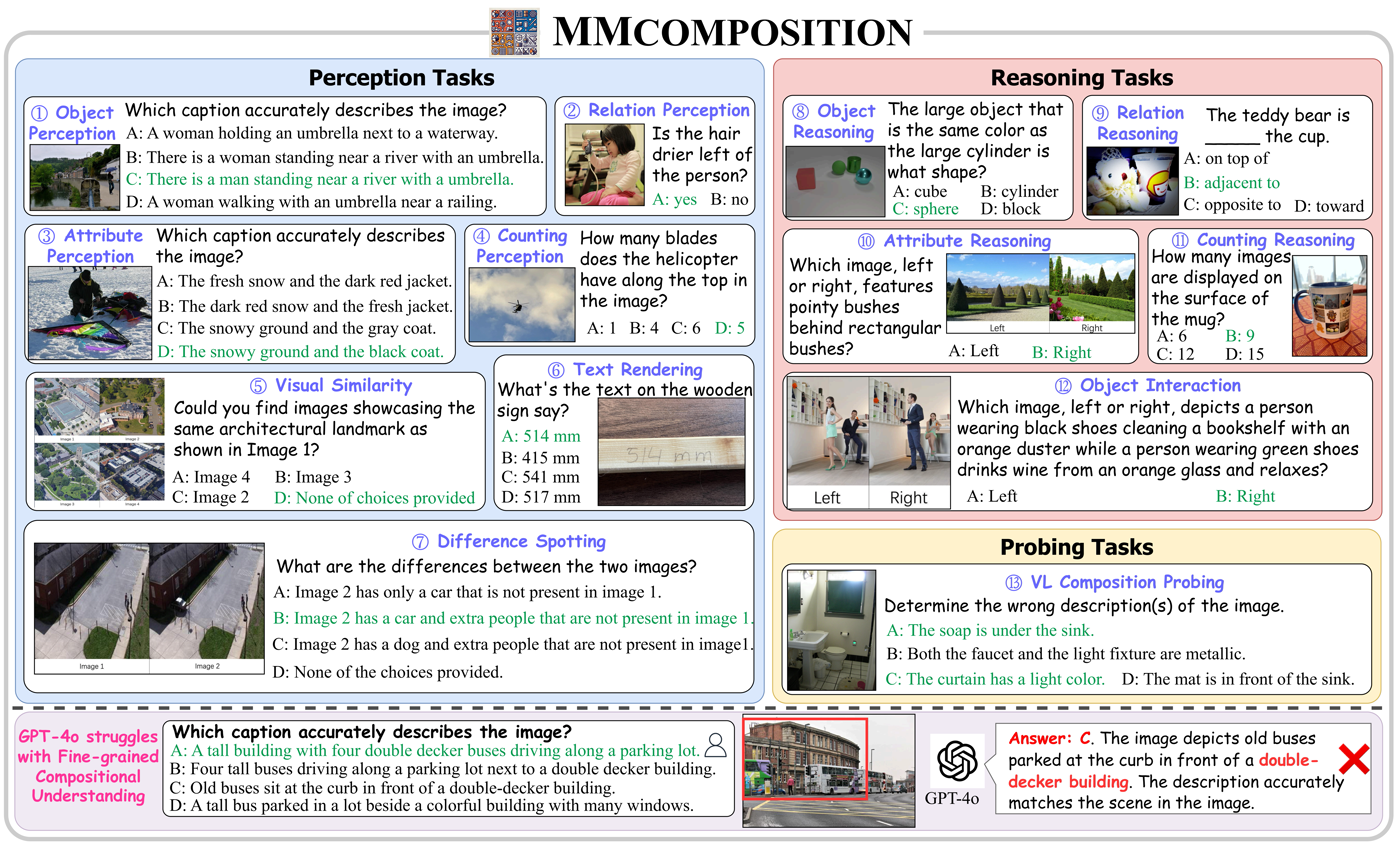 Hang Hua*, Yolo Y. Tang*, Ziyun Zeng*, Liangliang Cao, Zhengyuan Yang, Hangfeng He, Chenliang Xu, and Jiebo LuoTransactions on Machine Learning Research (TMLR), 2026
The advent of large Vision-Language Models (VLMs) has significantly advanced multimodal understanding, enabling more sophisticated and accurate integration of visual and textual information across various tasks, including image and video captioning, visual question answering, and cross-modal retrieval. Despite VLMs’ superior capabilities, researchers lack a comprehensive understanding of their compositionality – the ability to understand and produce novel combinations of known visual and textual components. Prior benchmarks provide only a relatively rough compositionality evaluation from the perspectives of objects, relations, and attributes while neglecting deeper reasoning about object interactions, counting, and complex compositions. However, compositionality is a critical ability that facilitates coherent reasoning and understanding across modalities for VLMs. To address this limitation, we propose MMCOMPOSITION, a novel human-annotated benchmark for comprehensively and accurately evaluating VLMs’ compositionality. Our proposed benchmark serves as a complement to these earlier works. With MMCOMPOSITION, we can quantify and explore the compositionality of the mainstream VLMs. Surprisingly, we find GPT-4o’s compositionality inferior to the best open-source model, and we analyze the underlying reasons. Our experimental analysis reveals the limitations of VLMs in fine-grained compositional perception and reasoning, and points to areas for improvement in VLM design and training. Resources available at: https://hanghuacs.github.io/MMComposition/
@article{hua2024mmcomposition, title = {MMCOMPOSITION: Revisiting the Compositionality of Pre-trained Vision-Language Models}, author = {Hua, Hang and Tang, Yolo Y. and Zeng, Ziyun and Cao, Liangliang and Yang, Zhengyuan and He, Hangfeng and Xu, Chenliang and Luo, Jiebo}, journal = {Transactions on Machine Learning Research (TMLR)}, year = {2026}, } - CVPR
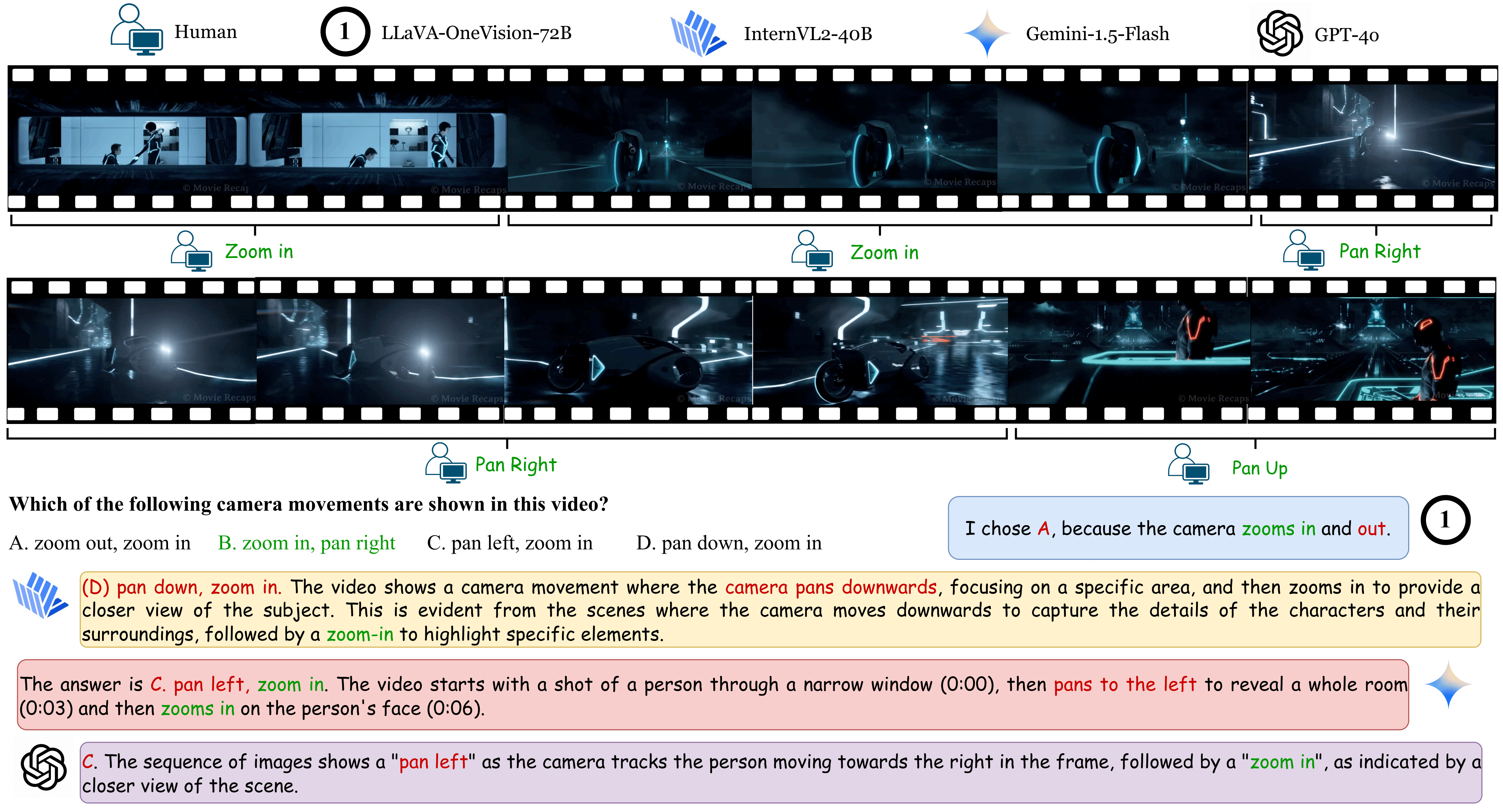 Yolo Y. Tang*, Junjia Guo*, Hang Hua, Susan Liang, Mingqian Feng, Xinyang Li, Rui Mao, Chao Huang, Jing Bi, Zeliang Zhang, and 2 more authorsIn Proceedings of the Computer Vision and Pattern Recognition Conference (CVPR), 2025
@inproceedings{tang2024vidcompostion, title = {VidComposition: Can MLLMs Analyze Compositions in Compiled Videos?}, author = {Tang, Yolo Y. and Guo, Junjia and Hua, Hang and Liang, Susan and Feng, Mingqian and Li, Xinyang and Mao, Rui and Huang, Chao and Bi, Jing and Zhang, Zeliang and Fazli, Pooyan and Xu, Chenliang}, booktitle = {Proceedings of the Computer Vision and Pattern Recognition Conference (CVPR)}, year = {2025}, pages = {8490-8500}, } - AAAI
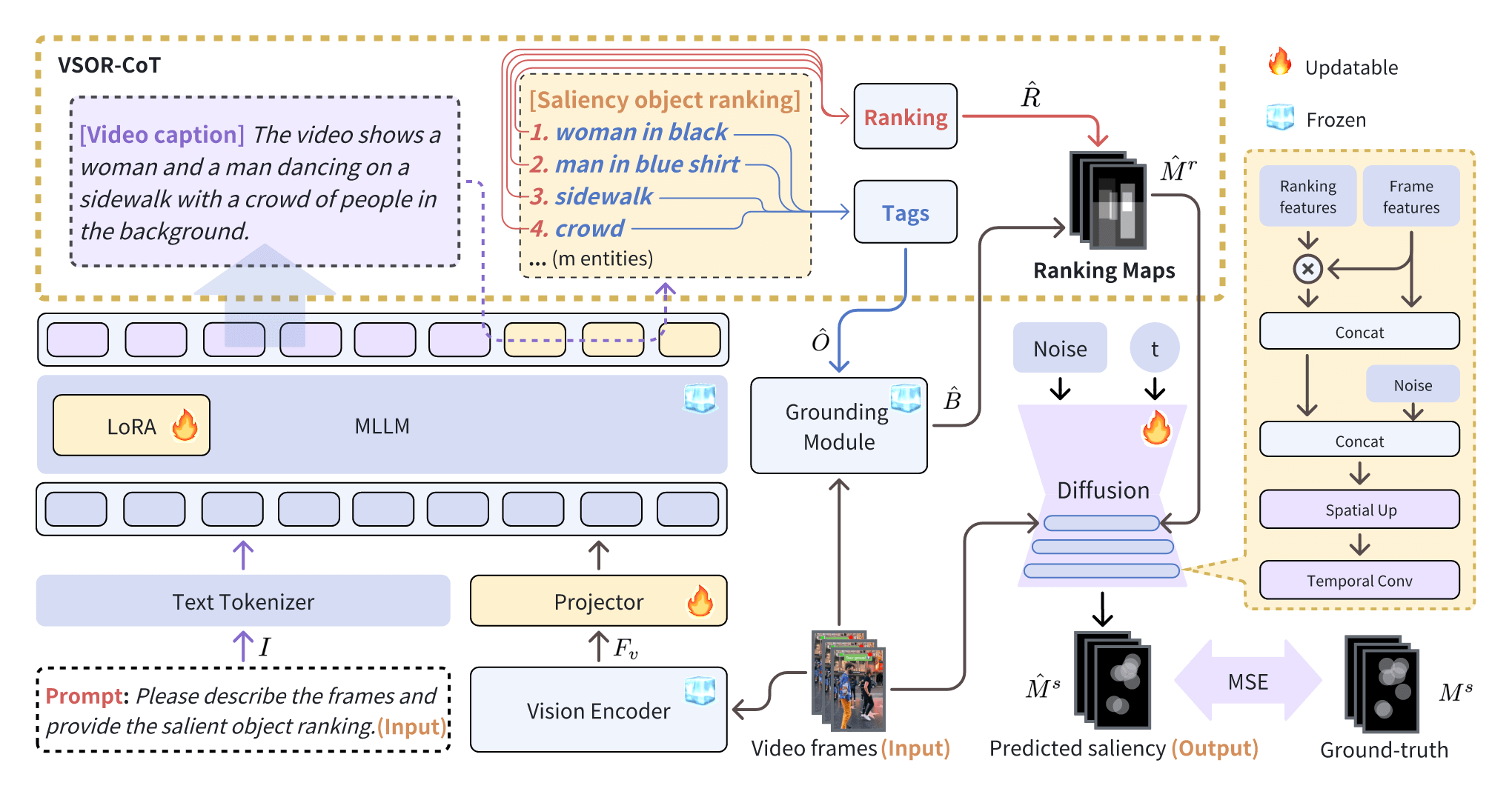 Yolo Y. Tang, Gen Zhan, Li Yang, Yiting Liao, and Chenliang XuIn Proceedings of the AAAI Conference on Artificial Intelligence (AAAI), 2025
Video saliency prediction aims to identify the regions in a video that attract human attention and gaze, driven by bottom-up features from the video and top-down processes like memory and cognition. Among these top-down influences, language plays a crucial role in guiding attention by shaping how visual information is interpreted. Existing methods primarily focus on modeling perceptual information while neglecting the reasoning process facilitated by language, where ranking cues are crucial outcomes of this process and practical guidance for saliency prediction. In this paper, we propose CaRDiff (Caption, Rank, and generate with Diffusion), a framework that imitates the process by integrating multimodal large language model (MLLM), a grounding module, and a diffusion model, to enhance video saliency prediction. Specifically, we introduce a novel prompting method VSOR-CoT (Video Salient Object Ranking Chain of Thought), which utilizes an MLLM with a grounding module to caption video content and infer salient objects along with their rankings and positions. This process derives ranking maps that can be sufficiently leveraged by the diffusion model to decode the saliency maps for the given video accurately. Extensive experiments show the effectiveness of VSOR-CoT in improving the performance of video saliency prediction. The proposed CaRDiff performs better than state-of-the-art models on the MVS dataset and demonstrates cross-dataset capabilities on the DHF1k dataset through zero-shot evaluation.
@inproceedings{tang2024cardiff, title = {CaRDiff: Video Salient Object Ranking Chain of Thought Reasoning for Saliency Prediction with Diffusion}, author = {Tang, Yolo Y. and Zhan, Gen and Yang, Li and Liao, Yiting and Xu, Chenliang}, booktitle = {Proceedings of the AAAI Conference on Artificial Intelligence (AAAI)}, year = {2025}, doi = {10.1609/aaai.v39i7.32785}, volume = {39}, number = {7}, pages = {7302-7310}, } -
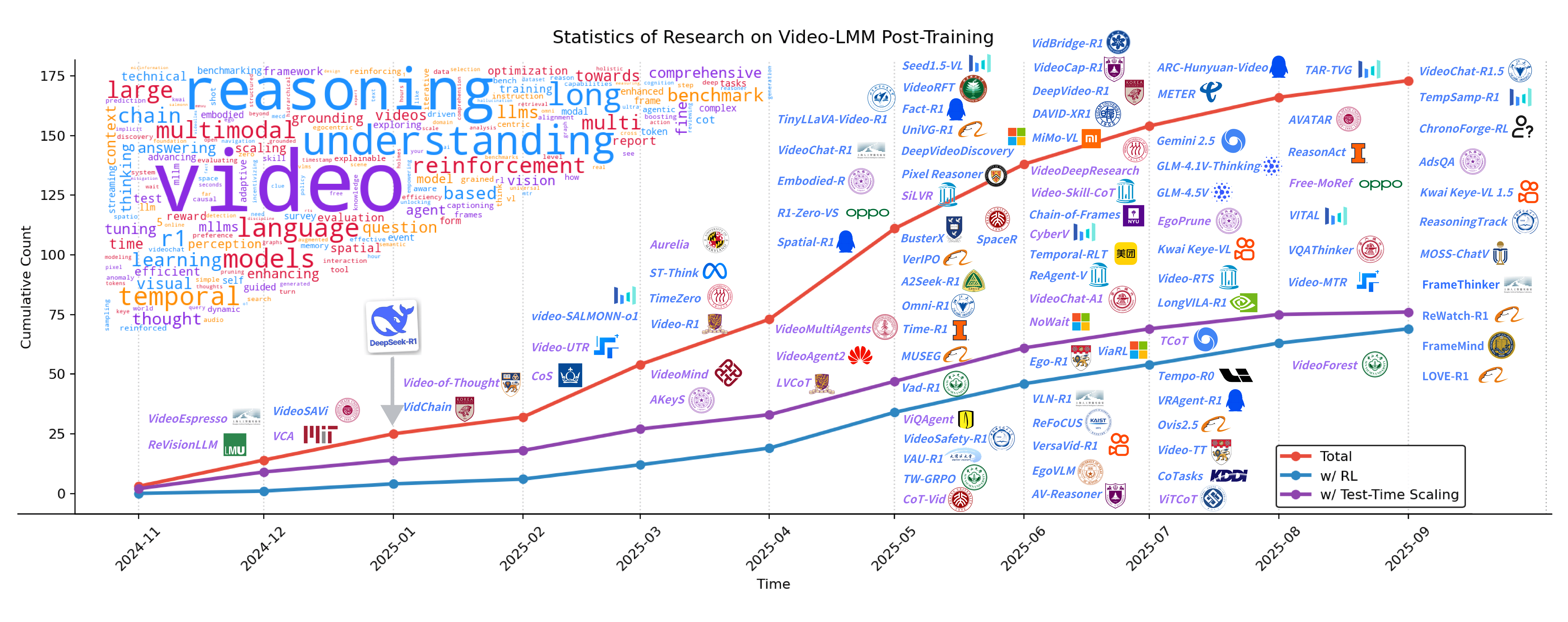 Yolo Y. Tang, Jing Bi, Pinxin Liu, Zhenyu Pan, Zhangyun Tan, Qianxiang Shen, Jiani Liu, Hang Hua, Junjia Guo, Yunzhong Xiao, and 17 more authorsarXiv preprint arXiv:2510.05034, 2025
Video understanding represents the most challenging frontier in computer vision. It requires models to reason about complex spatiotemporal relationships, long-term dependencies, and multimodal evidence. The recent emergence of Video-Large Multimodal Models (Video-LMMs), which integrate visual encoders with powerful decoder-based language models, has demonstrated remarkable capabilities in video understanding tasks. However, the critical phase that transforms these models from basic perception systems into sophisticated reasoning engines, post-training, remains fragmented across the literature. This survey provides the first comprehensive examination of post-training methodologies for Video-LMMs, encompassing three fundamental pillars: supervised fine-tuning (SFT) with chain-of-thought, reinforcement learning (RL) from verifiable objectives, and test-time scaling (TTS) through enhanced inference computation. We present a structured taxonomy that clarifies the roles, interconnections, and video-specific adaptations of these techniques, addressing unique challenges such as temporal localization, spatiotemporal grounding, long video efficiency, and multimodal evidence integration. Through systematic analysis of representative methods, we synthesize key design principles, insights, and evaluation protocols while identifying critical open challenges in reward design, scalability, and cost-performance optimization. We further curate essential benchmarks, datasets, and metrics to facilitate rigorous assessment of post-training effectiveness. This survey aims to provide researchers and practitioners with a unified framework for advancing Video-LMM capabilities. Additional resources and updates are maintained at: https://arxiv.org/abs/2510.05034
@article{tang2025videolmm_posttraining, title = {Video-LMM Post-Training: A Deep Dive into Video Reasoning with Large Multimodal Models}, author = {Tang, Yolo Y. and Bi, Jing and Liu, Pinxin and Pan, Zhenyu and Tan, Zhangyun and Shen, Qianxiang and Liu, Jiani and Hua, Hang and Guo, Junjia and Xiao, Yunzhong and Huang, Chao and Wang, Zhiyuan and Liang, Susan and Liu, Xinyi and Song, Yizhi and Huang, Junhua and Zhong, Jia-Xing and Li, Bozheng and Qi, Daiqing and Zeng, Ziyun and Vosoughi, Ali and Song, Luchuan and Zhang, Zeliang and Shimada, Daiki and Liu, Han and Luo, Jiebo and Xu, Chenliang}, journal = {arXiv preprint arXiv:2510.05034}, year = {2025}, } - AAAI Demo
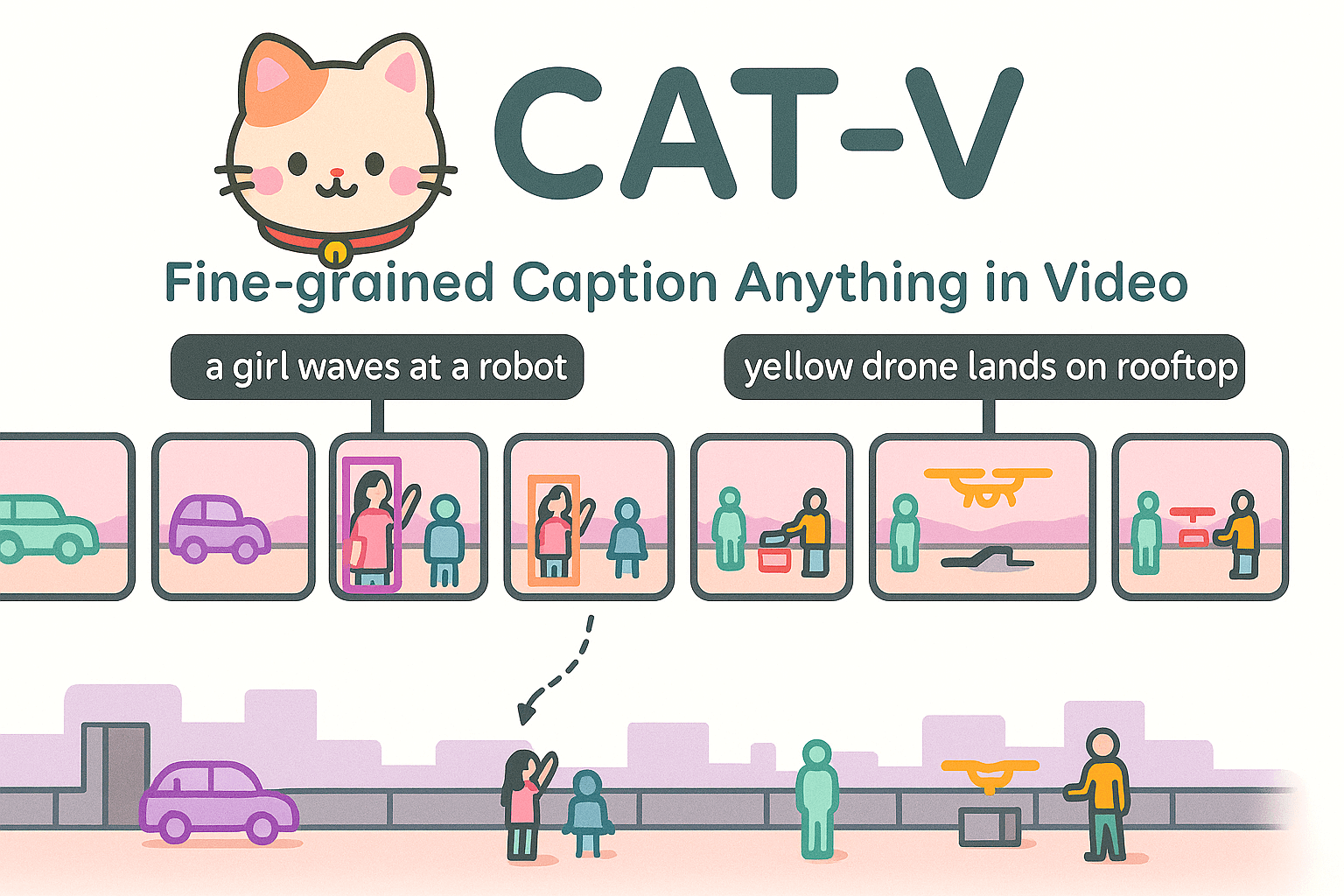 Yolo Y. Tang, Jing Bi, Chao Huang, Susan Liang, Daiki Shimada, Hang Hua, Yunzhong Xiao, Yizhi Song, Pinxin Liu, Mingqian Feng, and 9 more authorsBest Demo Award Runner-up at AAAI Demonstration Program, 2026
@article{tang2025catv, title = {Caption Anything in Video: Fine-grained Object-centric Captioning via Spatiotemporal Multimodal Prompting}, author = {Tang, Yolo Y. and Bi, Jing and Huang, Chao and Liang, Susan and Shimada, Daiki and Hua, Hang and Xiao, Yunzhong and Song, Yizhi and Liu, Pinxin and Feng, Mingqian and Guo, Junjia and Liu, Zhuo and Song, Luchuan and Vosoughi, Ali and He, Jinxi and He, Liu and Zhang, Zeliang and Luo, Jiebo and Xu, Chenliang}, journal = {Best Demo Award Runner-up at AAAI Demonstration Program}, year = {2026}, } - NeurIPS D&B
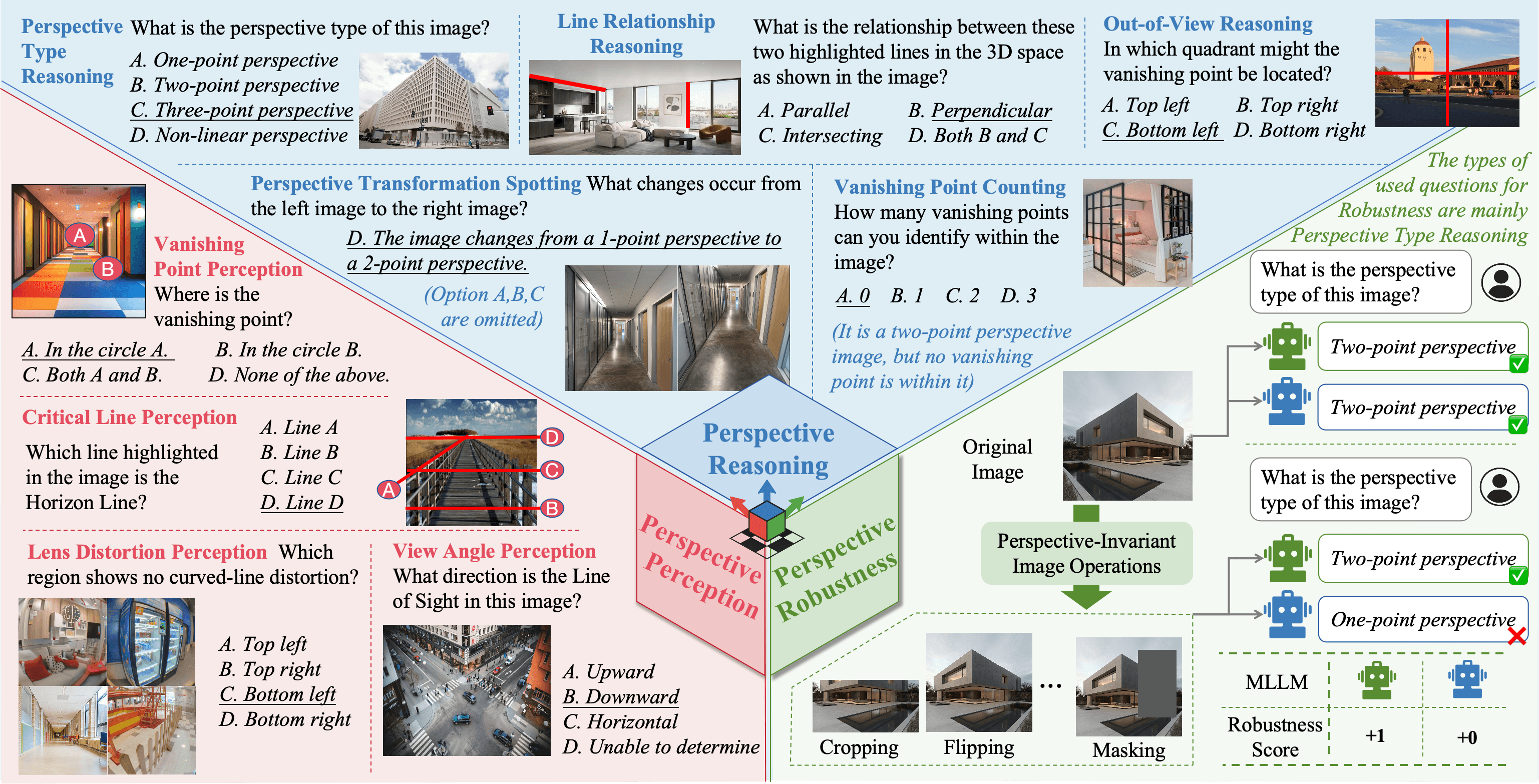 Yolo Y. Tang, Pinxin Liu, Zhangyun Tan, Mingqian Feng, Rui Mao, Chao Huang, Jing Bi, Yunzhong Xiao, Susan Liang, Hang Hua, and 4 more authorsThe Thirty-ninth Annual Conference on Neural Information Processing Systems (NeurIPS), 2025
@article{tang2025mmperspective, title = {MMPerspective: Do MLLMs Understand Perspective? A Comprehensive Benchmark for Perspective Perception, Reasoning, and Robustness}, author = {Tang, Yolo Y. and Liu, Pinxin and Tan, Zhangyun and Feng, Mingqian and Mao, Rui and Huang, Chao and Bi, Jing and Xiao, Yunzhong and Liang, Susan and Hua, Hang and Vosoughi, Ali and Song, Luchuan and Zhang, Zeliang and Xu, Chenliang}, journal = {The Thirty-ninth Annual Conference on Neural Information Processing Systems (NeurIPS)}, year = {2025}, } - CVPR Findings
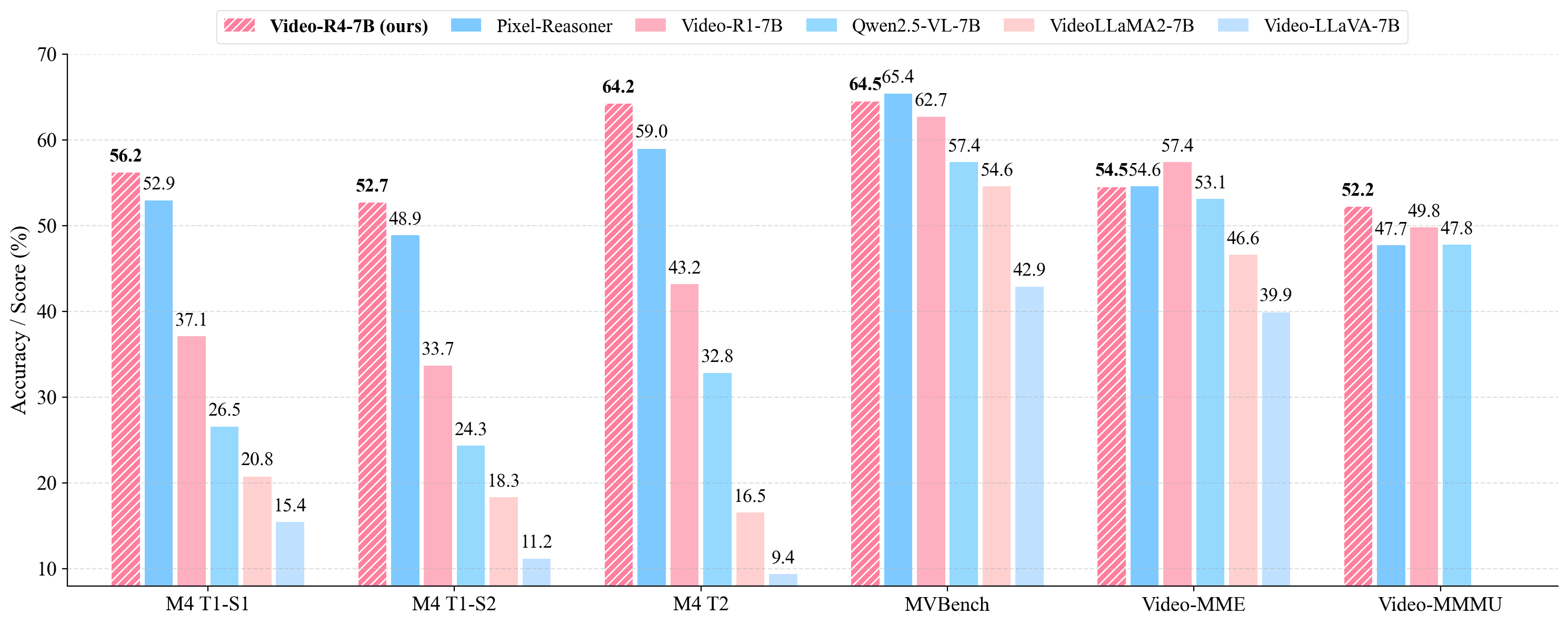 Yolo Y. Tang, Daiki Shimada, Hang Hua, Chao Huang, Jing Bi, Rogerio Feris, and Chenliang XuIn Proceedings of the Computer Vision and Pattern Recognition Conference (CVPR), 2026
@article{tang2025videor4, title = {Video-R4: Reinforcing Text-Rich Video Reasoning with Visual Rumination}, author = {Tang, Yolo Y. and Shimada, Daiki and Hua, Hang and Huang, Chao and Bi, Jing and Feris, Rogerio and Xu, Chenliang}, journal = {In Proceedings of the Computer Vision and Pattern Recognition Conference (CVPR)}, year = {2026}, pages = {8314-8325}, } - CVPR
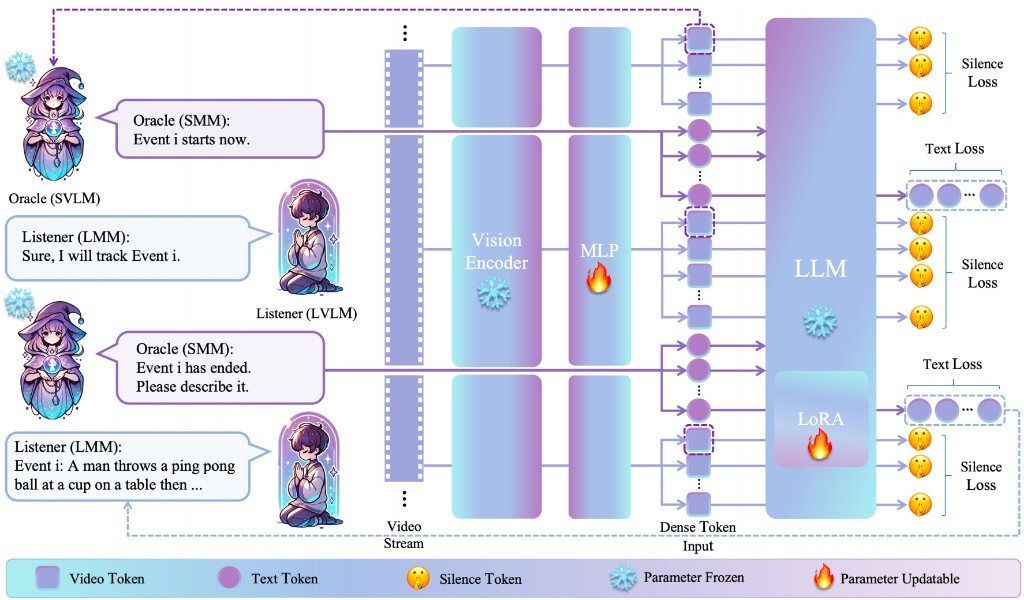 Yolo Y. Tang, Chao Huang, Susan Liang, Jing Bi, Yicheng Wang, Daiki Shimada, and Chenliang XuIn Proceedings of the Computer Vision and Pattern Recognition Conference (CVPR), 2026
Streaming dense video captioning requires real-time processing of continuous visual input while determining precisely when and what to caption. Current approaches primarily focus on designing complex external memory mechanisms, failing to leverage Large Multimodal Models’ (LMMs) inherent long-context capabilities. Moreover, existing methods employing threshold-based caption triggering face a severe Threshold-Gated Discrepancy (TGD) problem, a training-inference mismatch arising from data imbalance, where models predominantly predict silence tokens, requiring thresholds that vary drastically across videos with extremely narrow effective ranges. We introduce Takusen, an asynchronous temporal modeling two-agent framework comprising a Small Multimodal Model (SMM) as an Oracle agent and an LMM as a Listener agent. The Oracle agent processes sparse video inputs at an accelerated rate to detect event boundaries, while the Listener agent processes dense inputs to generate accurate captions when prompted by the Oracle’s signals. This architecture eliminates threshold dependencies by fundamentally changing how silence/generation decisions are made, resolving the TGD problem. To enhance robustness against boundary prediction instabilities, we integrate uniformly distributed fixed decoding points with Oracle-predicted boundaries. Experiments on ActivityNet Captions and YouCook2 datasets demonstrate that Takusen achieves state-of-the-art performance with a simpler and more efficient design that balances temporal sensitivity with descriptive accuracy.
@article{tang2026takusen, title = {Asynchronous Temporal Modeling with Two-Agent Framework for Streaming Dense Video Captioning}, author = {Tang, Yolo Y. and Huang, Chao and Liang, Susan and Bi, Jing and Wang, Yicheng and Shimada, Daiki and Xu, Chenliang}, journal = {In Proceedings of the Computer Vision and Pattern Recognition Conference (CVPR)}, year = {2026}, pages = {2799-2810}, } - ACM MM
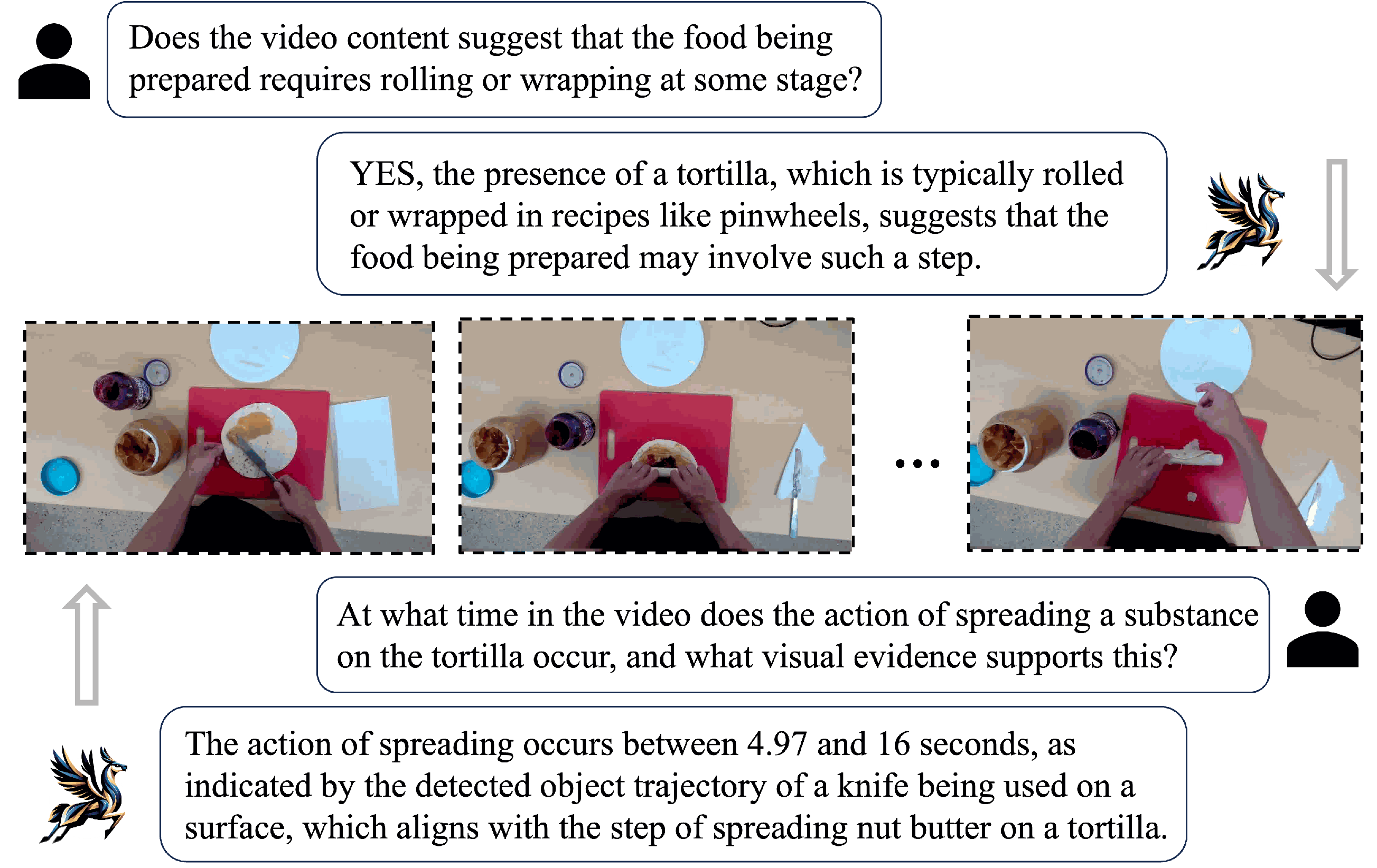 Jing Bi, Yolo Y. Tang, Luchuan Song, Ali Vosoughi, Nguyen Nguyen, and Chenliang XuIn Proceedings of the 32nd ACM International Conference on Multimedia (ACM MM), 2024
The rapid evolution of egocentric video analysis brings new insights into understanding human activities and intentions from a first-person perspective. Despite this progress, the fragmentation in tasks like action recognition, procedure learning, and moment retrieval, etc., coupled with inconsistent annotations and isolated model development, hinders a holistic interpretation of video content. In response, we introduce the EAGLE (Egocentric AGgregated Language-video Engine) model and the EAGLE-400K dataset to provide a unified framework that integrates various egocentric video understanding tasks. EAGLE-400K, the first large-scale instruction-tuning dataset tailored for egocentric video, features 400K diverse samples to enhance a broad spectrum task from activity recognition to procedure knowledge learning. Moreover, EAGLE, a strong video-based multimodal large language model (MLLM), is designed to effectively capture both spatial and temporal information. In addition, we propose a set of evaluation metrics designed to facilitate a thorough assessment of MLLM for egocentric video understanding. Our extensive experiments demonstrate EAGLE’s superior performance over existing models, highlighting its ability to balance task-specific understanding with comprehensive video interpretation. With EAGLE, we aim to pave the way for novel research opportunities and practical applications in real-world scenarios.
@inproceedings{bi2024eagle,
  title = {EAGLE: Egocentric AGgregated Language-video Engine},
  author = {Bi, Jing and Tang, Yolo Y. and Song, Luchuan and Vosoughi, Ali and Nguyen, Nguyen and Xu, Chenliang},
  booktitle = {Proceedings of the 32nd ACM International Conference on Multimedia (ACM MM)},
  year = {2024},
  pages = {1682--1691},
  doi = {10.1145/3664647.3681618},
  publisher = {Association for Computing Machinery},
}